ONLINE COURSE · A1 LEVEL
German A1 online course for Thai-speaking beginners
The planned GERMANYUM German A1 online course combines Thai-supported explanations with a structured twelve-module path, active exercises and all four skills. Course access, price and duration will be published only when they are real and tested.
Status: in development; no public price, start date or payment route yet.
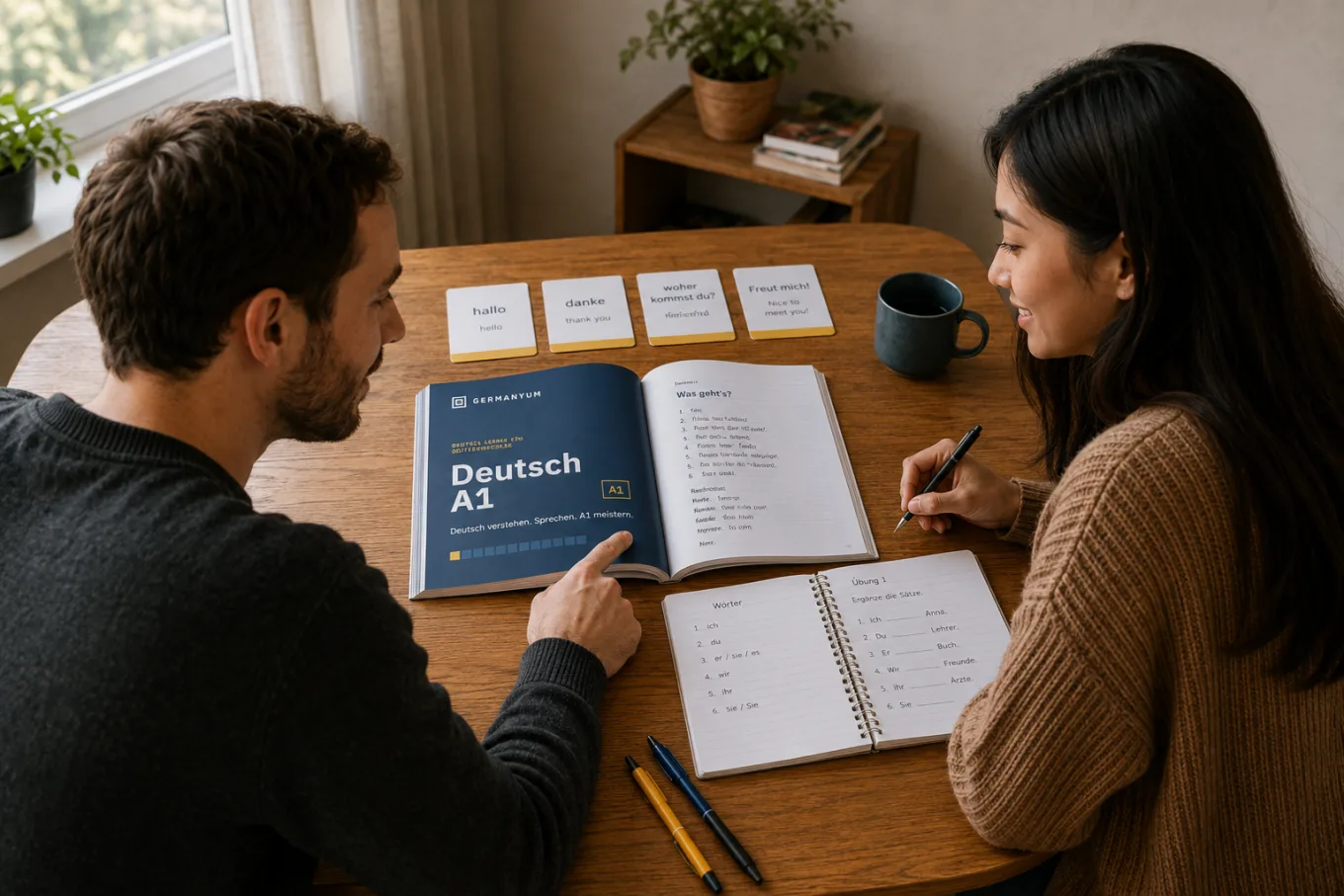
COURSE FORMAT
Learn in manageable units and see the next step
The planned structure organises A1 into 12 modules. Lessons, exercises and review are connected; final details will be published only after linguistic and subject review.
Audience
Complete beginners and learners who want to rebuild their A1 foundations.
Language of explanation
Thai for explanations; German for examples, dialogues and practice.
Learning outcome
Build foundational knowledge and skills for familiar communication situations at A1 level.
Delivery mode
A modular online course; no binding duration, workload or schedule has been published yet.
COURSE STRUCTURE
From sounds and writing to familiar communication situations
Each stage moves from understanding and examples to practice and review.
- 01
Sounds and writing
Read and pronounce basic words while noticing relevant differences from Thai.
- 02
Personal information and daily life
Introduce yourself, ask for information and discuss time, family and routine.
- 03
Home, food and shopping
Practise vocabulary and sentences for common situations.
- 04
Grammar and four skills
Apply A1 structures in listening, speaking, reading and writing.
WHO THE COURSE IS FOR
Start German A1 online with clear assumptions and realistic outcomes
The course is designed for adult Thai speakers with no German or fragmented beginner knowledge. It starts from spelling, pronunciation and the first personal exchanges rather than assuming familiarity with European grammar terms. Learners need an internet-connected device and enough time to practise actively, not simply play lessons in the background.
Thai is used to explain meaning and important contrasts, while German remains visible and audible wherever the final course media supports it. Exercises ask learners to recognise, retrieve and use the target language. English is not required for the Thai learning route, although this English page explains the product for an international audience.
The intended outcome is practical elementary communication across familiar A1 situations. That is an educational objective, not a guaranteed completion date, examination result or visa outcome. Individual progress depends on starting point, repetition, participation and opportunities to use the language.
TWELVE MODULES
Follow a German A1 course structure from pronunciation to independent review
The confirmed architecture contains twelve modules. Opening units cover German reading and pronunciation, first conversations, numbers, time and appointments. Middle modules develop family, food, shopping, housing, routine, work, study, leisure and transport. Calls, messages and forms combine information across themes.
A later grammar module organises patterns that learners have already used rather than introducing a disconnected rule catalogue. Examination training and final review apply familiar language in original tasks. This progression allows vocabulary, form and skill objectives to return under increasing but controlled difficulty.
Module titles do not prove course completeness. Each lesson still needs a clear objective, examples, practice, feedback logic and a tested digital presentation. GERMANYUM will not advertise a lesson count, video total or media duration that has not been finalised in the actual course.
Foundation
Letters, sound contrasts, spelling, introductions, numbers, dates and time.
Everyday life
Family, food, shopping, housing, routine, work, learning and leisure.
Practical communication
Transport, appointments, calls, messages, forms and requests for clarification.
Consolidation
Grammar review, original A1-style practice and a structured final revision.
ACTIVE LEARNING
Use a lesson cycle that turns explanation into retrievable German
A lesson starts with a small communicative goal and a situation that makes it relevant. Learners see or hear a model, use Thai support to understand the important contrast and identify the reusable German pattern. The explanation stays short enough that practice remains the centre of the lesson.
Controlled exercises check meaning and form before freer production. A learner may select an answer, complete a phrase, reorder a sentence and then produce a personal version. Feedback needs to identify why an answer did not work instead of only showing red or green. The uncertain item returns after a delay.
The final step asks for transfer: the same pattern appears with a new person, time, object or situation. That variation shows whether the learner can use the structure rather than repeat one memorised sentence. Progress should reflect completed objectives and necessary review, not only opened pages.
FOUR LANGUAGE SKILLS
Connect German listening, speaking, reading and writing in one course
Reading and writing can grow through short notices, messages, forms and everyday details. Learners first locate specific information, then organise a brief response. Examples and checking criteria must remain accessible so that learners can understand the reason for a correction rather than copy a model blindly.
Speaking requires frequent retrieval. Prompts should lead to an answer aloud, a recorded response or an exchange with another person. The Partner Trainer may provide optional two-person practice, but a learner must not be forced to buy another product to complete a core course objective.
Listening claims depend on real media. Voice, recording quality, controls, transcript use and supported devices have to be tested before the website promises a specific audio library. Until that production is complete, GERMANYUM describes the planned skill balance without inventing recordings or speaker profiles.
PLATFORM AND ACCESSIBILITY
Make the online course usable on mobile, tablet and desktop
A learning platform must be readable at common screen sizes and usable without precise mouse movement. Navigation, answer controls and progress information cannot depend only on hover or colour. Keyboard focus, understandable labels, sufficient target sizes and clear error messages are part of course quality, not optional decoration.
Account flows matter as much as the lesson screen. Registration, password reset, repeat login, device change and interrupted sessions require practical testing. A paid learner has not received a functioning course merely because an administrator dashboard marks an order as complete.
When a learning management system is selected, it should own lessons and learning progress. WooCommerce should own product, price, order and refund. A defined connection between the two avoids duplicate price data and ensures that access responds consistently to confirmed payment and any later refund decision.
COURSE INFORMATION BEFORE PURCHASE
Compare price, access, support and content before a checkout appears
A real course offer must state price, ISO currency, tax treatment, included modules, access period, technical requirements, delivery timing and support route. If scheduled teaching or personal feedback is included, the mode, quantity, response time and responsible person also need to be visible before purchase.
These facts are not final. The current page therefore has no Offer node, fabricated rating or artificial availability message. A Course schema can describe the educational resource, but it cannot create a sale that the visible website and checkout do not support.
Once commerce is ready, the same source must feed the product page, basket, checkout, confirmation, account and structured data. A change in price or access cannot remain correct in only one place. This consistency protects learners and prevents misleading search results.
CHOOSING THE RIGHT COURSE
Evaluate an A1 online course by practice quality instead of marketing volume
A high number of videos or downloads does not guarantee a coherent learning path. Thai-speaking beginners should look for explicit objectives, relevant language contrasts, active exercises and planned revision. It should be clear what learners will be able to do after a module, not merely which topics appear on a list.
Support also needs a precise definition. Automated feedback, technical help and individual language correction are different services. If a provider offers one of them, the scope and response expectations should be stated. GERMANYUM will not use a generic promise of personal support until the responsible process exists.
The course may suit learners who value a guided sequence and digital progress. Adults who prefer printable independent work may choose the book, while those with a reliable partner may add structured speaking practice. The best route depends on learning conditions rather than a claim that one format works for everyone.
PROGRESS AND REVIEW
Measure useful German progress without turning completion into a score
Opening a lesson is not the same as learning its objective. Progress should reflect whether a learner can retrieve the target later, recognise it in a new context and produce a short understandable response. A completed indicator can therefore coexist with a visible review state.
The course should distinguish an incorrect answer caused by vocabulary, form, order or task understanding. That information gives the next exercise a purpose. It also prevents an attractive dashboard from hiding the fact that a learner repeatedly guesses the same item.
Any badge, certificate or completion statement must describe what it actually records. It cannot imply an official language certificate or a guaranteed A1 result. Examination providers remain responsible for their own assessments and evidence.
TRANSPARENT COURSE DATA
What is supported as Course data and what is not invented
Who is the German A1 online course for?
It is planned for adult Thai-speaking beginners and learners who need to reorganise basic knowledge. No previous German is assumed, but active practice and a suitable internet-connected device are necessary.
How many modules will the course contain?
The confirmed architecture contains twelve modules covering pronunciation, everyday themes, grammar, all four skills, original examination practice and revision. Final lesson and media counts are not yet published.
Will the course explain German in Thai?
Thai is intended as the main explanatory bridge for the Thai route. German remains the target language for words, sentences, dialogues and exercises.
Will the course include listening and speaking practice?
The curriculum connects listening, speaking, reading and writing. Exact audio, video, speaker and feedback features will be stated only after the materials and platform have been produced and tested.
How long will course access last?
The access period and expected course duration are not final. They will be displayed before purchase once product, platform and support data are confirmed.
What will the German A1 course cost?
No public price, currency or tax information is available yet. The page therefore does not show a false booking button or an Offer in structured data.
Does the course guarantee an A1 pass?
No. It aims to develop relevant language and responsible preparation, but cannot guarantee an examination result, learning time, visa or decision by an authority.
Do I need the self-study book or Partner Trainer too?
No. All three formats are intended to remain independent. The book and Partner Trainer can provide alternative or additional practice, but core course completion must not require another purchase.
COURSE STATUS
Factual Course markup, no Offer yet
Structured data contains the visible name, description, provider, language, A1 level and online format. Price, schedule, instructor and ratings are deliberately absent until approved facts exist.